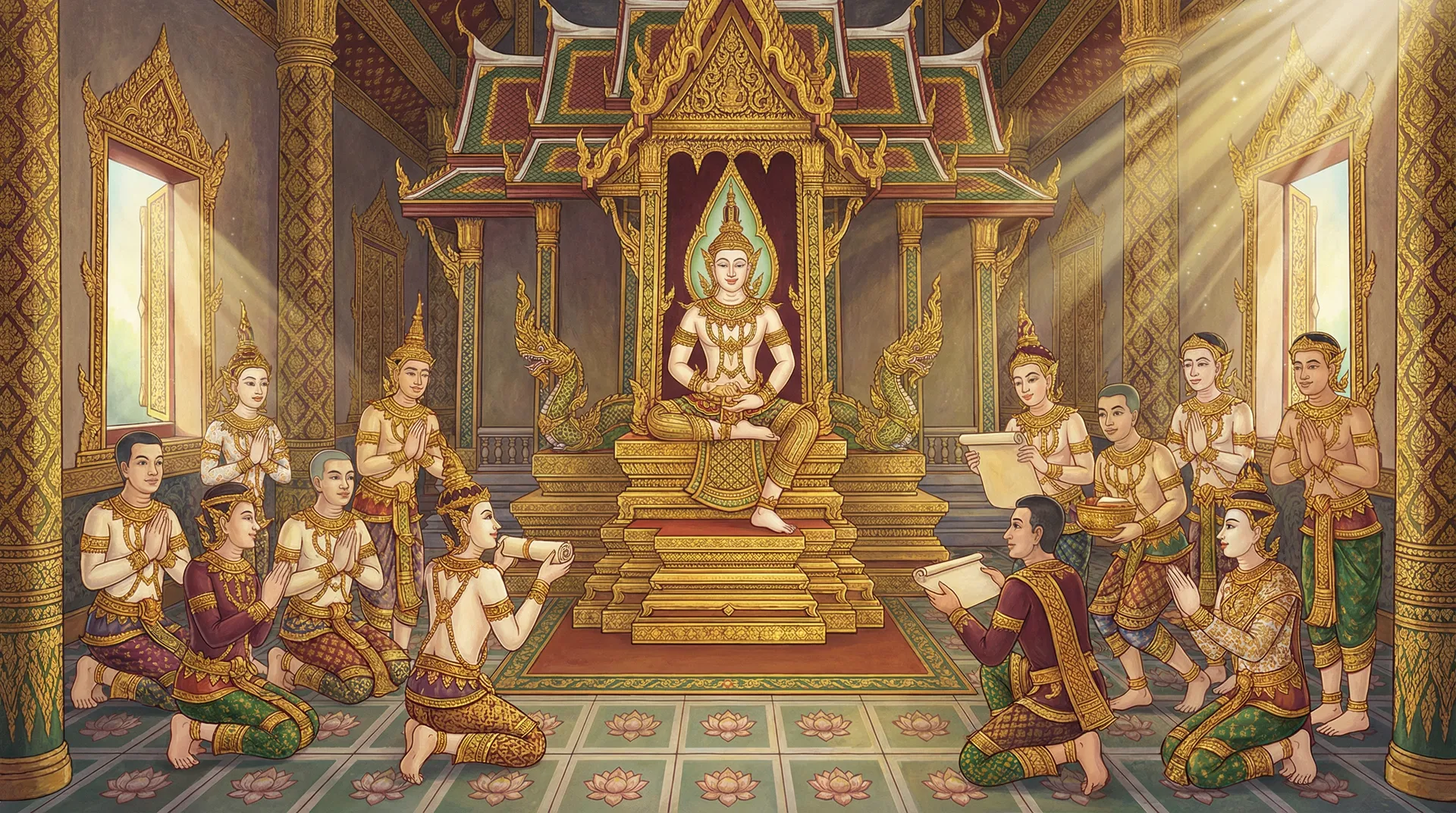
Mugapakkha Jataka
The Tale of the Silent Ascetic
In the heart of a vast and ancient forest, where sunlight dappled through a canopy of emerald leaves and the air hummed with the songs of unseen birds, there lived a wise and virtuous Bodhisattva. For countless lifetimes, he had cultivated the seeds of compassion and wisdom, preparing himself for the ultimate enlightenment. In this particular existence, he was born a human, blessed with a sharp intellect and a serene disposition. However, fate had dealt him a peculiar hand. From birth, he was mute, unable to utter a single sound. His parents, though loving, despaired at their son's silence, fearing for his future in a world that valued eloquent speech. But the Bodhisattva, even in his voiceless state, possessed a profound understanding of the world. He learned to communicate through gestures, expressions, and the quiet power of his gaze.
As he grew, his wisdom became renowned. People from distant villages, hearing tales of the silent sage who resided in the forest, would journey to seek his counsel. They would present their dilemmas, their hearts heavy with worry, and the Bodhisattva would listen with unwavering attention. With a gentle nod, a subtle tilt of his head, or a pointed finger, he would guide them towards the right path. His solutions were always insightful, his advice always just. He never offered empty platitudes; his wisdom was practical, born from deep observation and an innate understanding of human nature.
One day, a wealthy merchant arrived at the Bodhisattva's dwelling. The merchant was known for his greed and his ruthless business practices. He had amassed a fortune, but his heart was filled with anxiety. He feared losing his wealth and harbored a deep mistrust of everyone around him. He approached the Bodhisattva, his face etched with worry lines, and gestured that he had a problem he wished to discuss. The Bodhisattva, sensing the man's inner turmoil, invited him to sit.
The merchant, through a series of elaborate gestures, explained his predicament. He was preparing for a long sea voyage to expand his trade. He had entrusted a significant portion of his wealth to his most trusted captain, a man he had known for years. Yet, as the departure date neared, a gnawing suspicion began to plague him. What if the captain betrayed him? What if he sailed away with the treasure? His hands trembled as he depicted his fears, his eyes wide with apprehension.
The Bodhisattva listened intently. He observed the merchant's restless movements, the sweat beading on his brow, the way he constantly clutched at his chest. The Bodhisattva understood that the merchant's suffering stemmed not from the potential loss of wealth, but from his own unchecked greed and his inability to trust. He knew that simply telling the merchant to trust his captain would be futile. He needed to show him.
The Bodhisattva rose and, with a calm demeanor, led the merchant to a nearby stream. He picked up a small, smooth stone and placed it in the merchant's hand. Then, he pointed to the flowing water. The merchant looked confused. The Bodhisattva then gently took the stone back and tossed it into the stream. It sank immediately.
He then gestured to the merchant to pick up a large, hollow reed. He placed the reed in the water, and it floated effortlessly. He then pointed to the reed and then to the merchant's chest, making a motion of holding something precious within.
The merchant, though still bewildered, began to grasp the subtle message. The stone, heavy and dense, represented the merchant's own mind, burdened by suspicion and greed, which caused him to sink into anxiety. The hollow reed, light and buoyant, represented a mind free from such burdens, capable of floating serenely above the worries of the world.
The Bodhisattva then gestured towards the merchant's captain, who was standing by, waiting for his employer's instructions. He pointed to the captain and then made a gesture of a sturdy, hollow vessel, capable of carrying great weight without being weighed down itself. He then pointed to the merchant's own chest again, implying that if the merchant could empty his own mind of its heavy burdens, he would be able to trust and sail with ease.
The merchant sat in silence, pondering the Bodhisattva's silent sermon. He looked at the stream, at the floating reed, and then at his own hands, which had been clutching his chest in anxiety. A slow understanding dawned upon him. His greed had made him heavy, his suspicion had made him sink. If he could lighten his own load, he could trust others and find peace.
He bowed deeply to the Bodhisattva, a gesture of profound gratitude. Though no words were exchanged, a deep connection was forged. The merchant, inspired by the silent sage's wisdom, decided to sail with his captain, not with a heart full of suspicion, but with a mind lighter than a reed. He learned to let go of his excessive attachment to wealth and to cultivate a spirit of trust. His voyage was successful, and he returned not only richer in possessions but also richer in spirit, having found a measure of inner peace.
The Bodhisattva continued to live in his forest hermitage, a beacon of silent wisdom, demonstrating that true understanding and guidance can transcend the limitations of speech. His life was a testament to the power of quiet observation, deep compassion, and the profound truths that can be conveyed without a single uttered word.
— In-Article Ad —
💡Moral of the Story
True wisdom and guidance can be communicated through actions and understanding, transcending the need for spoken words. Cultivating inner peace and letting go of greed and suspicion are essential for trust and well-being.
Perfection: Wisdom (Prajna)
— Ad Space (728x90) —
More Jataka Tales You May Enjoy
 81Ekanipāta
Māhāsukha Jātaka
Māhāsukha Jātaka Long ago, in the bustling city of Mithila, lived a king named Brahmadatta. He was a...
💡 True happiness is found not in external possessions or status, but in inner peace, detachment, and boundless compassion.
 478Terasanipāta
Titthira Jataka
Titthira Jataka In the verdant kingdom of Kosala, nestled beside the gentle flow of the Sarayu River...
💡 The truth, though sometimes difficult to speak or to hear, ultimately prevails and exposes the destructive consequences of greed and dishonesty.
5EkanipātaThe Monkey King's Sacrifice
The Monkey King's SacrificeIn the dense, emerald heart of the Vindhya Mountains, where ancient trees...
💡 True leadership is defined by selfless sacrifice for the well-being of others.
14EkanipātaThe Bodhisatta as a Hunter
The Bodhisatta as a HunterIn the dense, untamed wilderness of the Himalayas, where snow-capped peaks...
💡 True compassion transcends self-preservation, and great sacrifices bring immeasurable blessings.
99EkanipātaThe Tale of King Videha
In the prosperous city of Mithila, situated in the thriving kingdom of Videha, renowned for its comm...
💡 True wealth is found in selfless giving and compassion. Generosity, when offered with a pure heart, can bring about miracles and spiritual abundance.
25EkanipātaThe Bodhisatta as a Swan
The Bodhisatta as a SwanIn the shimmering expanse of a celestial lake, where the water was as clear ...
💡 True compassion knows no bounds, and celestial beings are called to act when suffering is present, bringing salvation.
— Multiplex Ad —